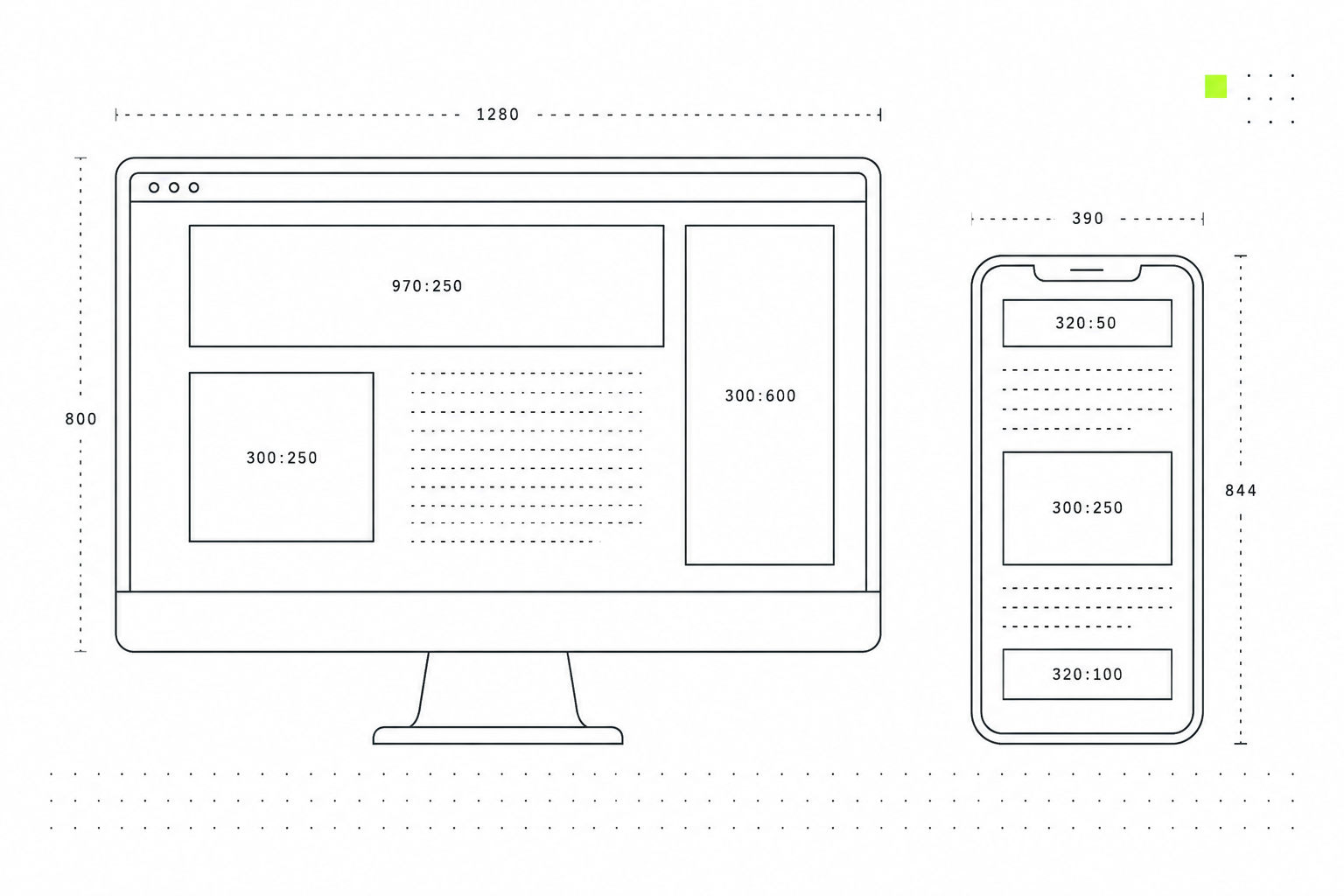
IAB formats are industry standards for digital ad creatives that make them easier to use across different websites and apps. For advertisers, they provide a shared basis for planning creative development, production and media buying. However, they guarantee neither acceptance by every media sales partner nor campaign success. What matters is choosing formats that fit your objective, booked placements and the browsing habits of your target audience in DACH.
What exactly are IAB formats?
IAB stands for Interactive Advertising Bureau. In everyday advertising, the term “IAB formats” often refers to standardised display banner sizes. However, the standards and recommendations of the IAB and IAB Tech Lab go beyond pixel dimensions. They also address technical requirements and the quality of digital advertising experiences.
An important point for your planning: not every specification a media sales partner calls a standard is automatically a universally applicable IAB standard. Alongside international recommendations, there are local market practices and individual specifications set by publishers, media sales partners and advertising platforms.
Standardised does not mean usable everywhere without changes
A banner with the right dimensions can still be rejected if it does not meet the requirements of the booked placement. Relevant factors include file size, animation, delivery method and tracking requirements.
For marketing decision-makers, the implication is clear: your format list should be based on your specific media plan. A supposedly universal package that has not been checked against your booked placements can lead to additional costs and delays.
Which formats should you know for media planning?
Display advertising includes both fixed pixel sizes and flexible formats. Fixed sizes remain widely used in the market. Flexible approaches focus more on aspect ratios and the available ad space. The inventory in question determines what can actually be booked.
The following overview shows common display formats. It is not a complete list of all current IAB specifications, nor does it guarantee availability with individual media outlets.
| Format | Common size in pixels | What advertisers should know |
|---|---|---|
| Medium Rectangle | 300 × 250 | Widely used across different editorial environments, often available on desktop and mobile |
| Leaderboard | 728 × 90 | Classic horizontal desktop format with limited height for messaging |
| Wide Skyscraper | 160 × 600 | Vertical desktop ad space, often placed beside content |
| Half Page | 300 × 600 | Larger vertical ad space with room for product visuals and brand impact |
| Billboard | 970 × 250 | Large desktop format often used for high-impact placements |
| Mobile Banner | 320 × 50 | Compact mobile ad space that requires a particularly focused message |
You can find additional context in our overview of HTML5 banner formats. The sizes your campaign needs should still be determined by the placements you actually book.
Size, design and delivery are separate decisions
A format such as 300 × 250 initially describes the dimensions, not how the ad is built. Depending on the placement, the same space can accommodate static images or animated HTML5 creatives.
Likewise, “programmatic” is not a format. It describes the automated buying and delivery of advertising inventory. Native ads, video and digital out-of-home advertising each have their own requirements and should not simply be treated as additional banner sizes.
Which IAB formats suit your campaign objective?
The best selection is not the longest list of formats. It is the one that provides access to enough relevant inventory and communicates your message effectively.
Brand awareness and product launches
Large placements can give your branding, product imagery and message more space. This makes them an attractive option for product launches or offers that need more explanation. However, their impact depends heavily on context, placement, viewability and creative execution.
A large format is therefore not automatically the better investment. If it is rarely viewable or appears in an unsuitable context, the extra space offers little benefit.
Sales and lead generation
For sales-focused campaigns, a clear offer, an easy-to-understand call to action and a suitable landing page are essential. Widely used standard sizes can open up a range of placements and support ad delivery.
Do not assess performance on clicks alone. What matters is qualified enquiries, purchases or other defined business outcomes. A format with a high click-through rate may deliver less business value than one that attracts fewer but more relevant visitors.
Regional campaigns in Austria
For a business in Linz, Wels or Vienna, inventory with the right regional coverage may matter more than a particularly broad selection of formats. The key question is whether the available placements reach your target audience in the intended catchment area.
For programmatic advertising, the format mix, regional availability and audience targeting should therefore be planned together. Overly restrictive combinations can limit the available reach.
What does your choice of formats mean for your budget?
There is no uniform production or media rate for IAB formats. A reliable cost estimate is only possible once the number of formats, design, variants and booked advertising environments have been established. Without that scope, a flat euro amount would have little value.
When comparing proposals, you should be able to identify three separate cost categories:
- Concept and design: How will the campaign idea be adapted to different ad spaces?
- Production and quality assurance: How many sizes, languages, offer variants and technical checks are included?
- Media and campaign management: What are the costs for ad inventory, delivery, optimisation and reporting?
Additional sizes do not just require more production work. They also need approvals and checks. Conversely, too narrow a selection can rule out suitable placements.
The most cost-effective approach is therefore a well-justified core set with optional additions. The agency should be able to explain which relevant placements each additional size makes accessible. For HTML5 banner production, it is also important to check whether technical adaptations and approvals from media sales partners are included in the proposed scope.
Mistakes that waste your budget
Commissioning formats before finalising the media plan
If you have a standard package produced before selecting your placements, you risk missing required sizes or ending up with unusable creatives. Additional adaptations shortly before launch can put pressure on your schedule and budget.
Applying one design unchanged across all sizes
A wide desktop placement and a compact mobile banner offer different possibilities. Simply shrinking the same content often compromises readability and clarity. Good adaptations preserve the campaign idea while accounting for the available space.
Creating too many variants without enough media budget
A large number of formats, creative concepts and target audiences can fragment a campaign unnecessarily. If individual combinations receive very little delivery, it becomes difficult to assess their results. More choice does not automatically mean more insight.
Confusing technical approval with advertising effectiveness
A technically correct creative can still have a weak message. Conversely, a compelling design offers little value if it is not approved in time. Production, media and marketing teams need to address both dimensions of quality.
What to look for when choosing an agency
The right agency will not simply sell you as many banner sizes as possible. It will explain the rationale behind its selection and take clearly defined responsibility through to the delivery of ready-to-use creatives.
Pay particular attention to these points in your discussions:
- Are the campaign objective, target audience and media plan discussed before costs are calculated?
- Are mobile usage and different advertising environments taken into account?
- Are revision rounds, technical checks and responsibilities clearly defined?
- Are later changes to prices, offers or languages considered?
- Is it clear who will respond to questions from the media sales partner?
A professionally managed project includes alignment on requirements, a clear design rationale, agreed approval stages and a quality-checked handover. You should know which decisions your team needs to make and which coordination tasks the agency will handle. Tracking and personal data also require a legal or specialist data protection review. IAB compliance is not a substitute for this.
Frequently asked questions
Are IAB formats the same in Austria, Germany and Switzerland?
Many common sizes are used in all three markets. Availability, technical requirements and booking terms still vary by publisher and media sales partner. The specifications of the placements you actually book are what matter.
How many banner formats does a campaign need?
There is no useful one-size-fits-all number. Your requirements depend on the campaign objective, devices, inventory and budget. A well-justified core set is usually more helpful than an extensive list with no connection to the media plan.
Do IAB-compliant banners guarantee better results?
No. Standards make collaboration and technical deployment easier. Advertising effectiveness also depends on the message, context, viewability, audience targeting and landing page. Technical compliance is a foundation, not a promise of success.
Have your format selection reviewed alongside your media plan and production scope before commissioning a banner package. Based in Linz and Vienna, artworx supports you with format guidance, design and production for campaigns in Austria and DACH. A 45-minute consultation can help establish the right scope for your project.