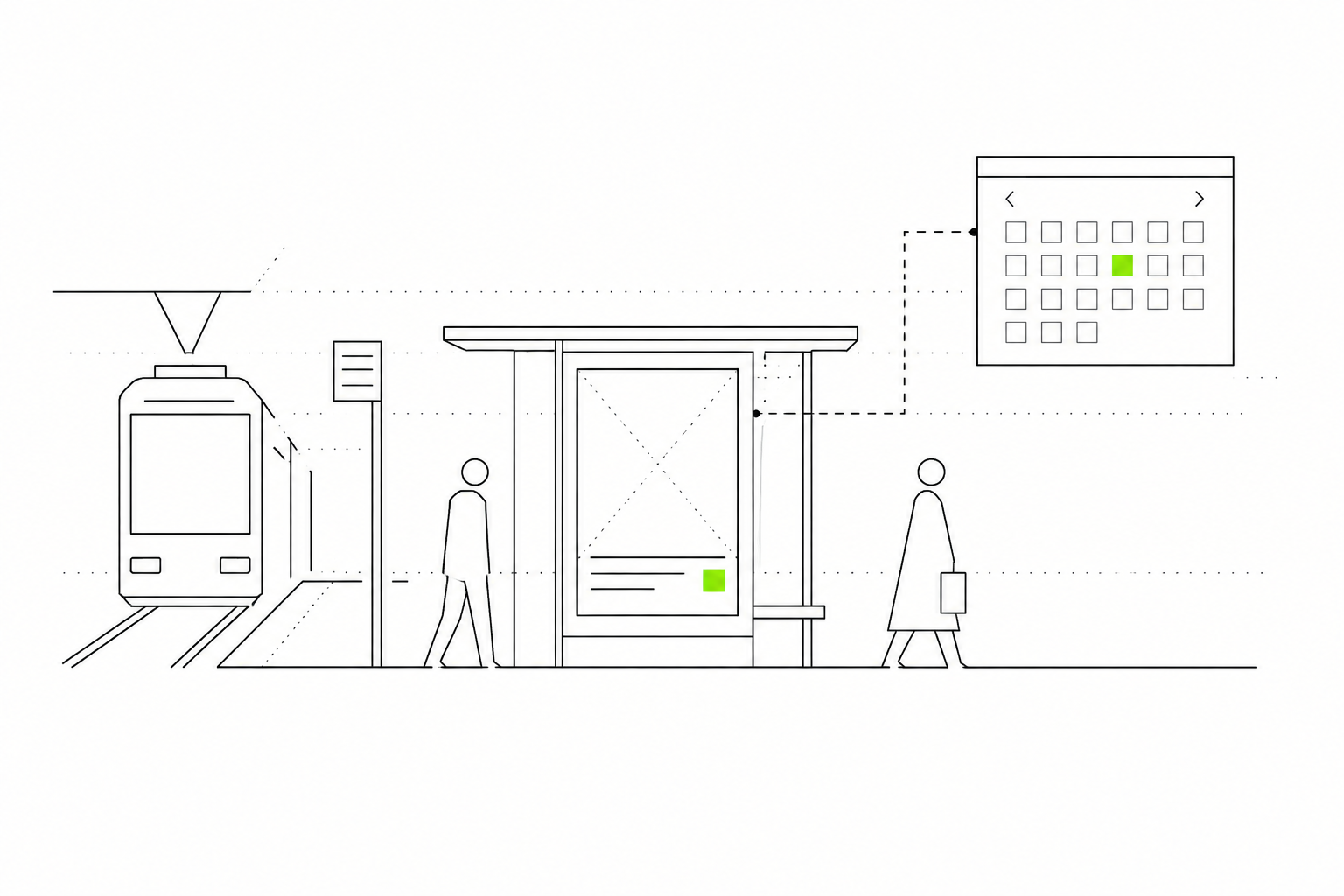
DOOH stands for Digital Out of Home, meaning advertising on digital screens in public spaces and publicly accessible venues. For advertisers, DOOH is particularly useful for reaching people on the move, building a regional presence or delivering messages at relevant times and locations. In Austria, you can book these spaces directly with media owners or, depending on the inventory, programmatically through buying platforms.
What exactly is DOOH?
DOOH includes digital ad spaces along roads, in railway stations, shopping centres, shops and other publicly accessible buildings. People see these ads away from their own devices, for example while commuting, shopping or waiting.
Unlike a smartphone, the screen does not belong to an individual. DOOH is generally a medium that reaches several people at once. This makes it particularly effective for messages that are easy to grasp at a glance and for building a visible brand presence.
It is important to distinguish between a screen and bookable ad space: a digital display is not automatically available for advertising. What matters for your campaign is which locations are actually available, which audiences spend time there and what ad delivery conditions apply.
What types of DOOH environments are available?
- Roads and urban areas: Digital ad spaces that build visibility across the city and along relevant routes.
- Railway stations and transport hubs: Opportunities to reach commuters, travellers and passers-by.
- Shopping centres and retail: Advertising in shopping environments, sometimes close to the point of purchase.
- Leisure and service venues: Screens in gyms or waiting areas, for example, depending on the available network.
Not every environment suits every brand. A regional retail promotion needs different locations from a nationwide brand campaign across Austria.
DOOH vs. traditional outdoor advertising
Traditional outdoor advertising, often referred to as OOH, includes printed posters and static ad spaces. DOOH is its digital counterpart. The key difference is not just the screen, but the flexibility of ad delivery.
| Criterion | Traditional outdoor advertising | DOOH |
|---|---|---|
| Ad format | Printed or static creative | Digital creative, sometimes animation or video |
| Creative changes | Require physical replacement | Can be made digitally after approval |
| Scheduling | Usually based on fixed display periods | Depending on the offering, individual days or time slots are also possible |
| Visibility | Creative remains continuously visible throughout the booking period | Often rotating ad spots in a loop |
| Buying | Usually based on location and period | Direct or, in some cases, programmatic |
This does not automatically make DOOH better. A traditional poster can make sense if you want a continuous presence at a specific location over a longer period. Digital ad spaces come into their own when creatives change, offers are time-sensitive or different regions need different messages.
The two formats can complement each other: static spaces provide continuity, while digital placements keep messaging current and attract additional attention.
When is DOOH worthwhile for your business?
DOOH is particularly relevant when a location has a clear connection to your offering. A business with branches in Linz, Wels and Vienna, for example, can build a presence in relevant catchment areas rather than relying solely on broad advertising across Austria.
Typical use cases include:
- Brand building: Visibility in selected cities or relevant everyday environments.
- Branch openings and events: Generating attention around a specific location and for a limited period.
- Retail promotions: Promoting offers in relevant shopping environments.
- Product launches: Adding reach alongside digital and traditional media.
- Regional campaigns: Different messages for different markets or locations.
DOOH is less suitable as a standalone channel if your offering requires a lot of explanation or targets only a very small audience that is difficult to reach through location-based placements. Direct online purchases are also harder to attribute than with a clickable ad. This calls for a realistic assessment of its role in the media mix.
How is DOOH booked in Austria?
Booking directly with a media owner
With a direct booking, ad spaces, networks, campaign periods and deliverables are agreed with the relevant provider. This can make sense for specific location requirements, larger visibility packages or campaigns planned well in advance.
What matters is exactly what is guaranteed: specific locations, ad frequency, share of a loop or other delivery metrics. Booking a week does not automatically mean your creative will be visible continuously on a digital screen.
Programmatic buying with pDOOH
Programmatic Digital Out of Home, or pDOOH, refers to the software-based buying of digital outdoor advertising. Available ad inventory is purchased and delivered through technology platforms according to agreed criteria.
This can allow more flexible selection by region, environment, day of the week or time of day. Context-based ad delivery, such as ads tailored to weather conditions, may also be possible depending on the provider and data integration. However, not every ad space supports every buying approach.
Programmatic does not necessarily mean an open auction or lower prices. There are various buying models, including agreed terms with selected providers. A Programmatic Advertising agency should explain which model suits your objective and what cost components are involved.
The most important difference from many online campaigns is that pDOOH typically targets situations and audience groups at a location, not an individually identified person in front of a screen.
Roughly how much does DOOH cost?
A general price range would offer little insight without knowing the location, campaign duration and scope of delivery. A geographically limited campaign requires a different investment from a broad campaign across several cities and networks.
Your total budget typically consists of several components:
- Media costs: For the booked ad delivery on the selected screens.
- Creative development and adaptations: For the core concept and suitable creative versions.
- Planning and management: For buying, coordination, quality control and reporting.
- Technology and data: Potential additional fees for programmatic campaigns.
Programmatic buying often uses a cost per thousand impressions, or CPM. What matters is how those impressions are calculated. A single ad play does not necessarily equal exactly one human viewing impression.
You should therefore compare quotes on a like-for-like basis. A low price is of little value if the locations, audience quality or delivery times do not suit your target audience. A sound budget decision requires a clearly defined plan with transparent assumptions.
What makes effective DOOH creative?
People often look at outdoor advertising only briefly. A clear main message, recognisable branding and good readability are therefore more important than including as many product details as possible. Animation can help attract attention, but the message should not require prolonged viewing to make sense.
Requirements also vary by location. Motion or video is not permitted everywhere. Sound is often unavailable. An existing social media ad is therefore not automatically suitable for DOOH.
If DOOH runs alongside display advertising, you need a consistent creative approach with separate adaptations for each channel. HTML5 banner production covers the online ads. DOOH versions must be adapted separately to meet the specifications of the booked screens.
How do you identify the right agency?
A good agency starts with your campaign objective, not the longest possible list of locations. It explains why certain environments make sense, which booking method is appropriate and which results can be assessed reliably.
Strategy, media planning, creative development, approvals and evaluation should come together in a clear, coordinated process. You need clearly assigned responsibilities and transparency about which services are included. References and work samples help you assess creative quality and relevant experience.
Measurement is particularly important: playback reports confirm that ads were delivered technically. Reach and impressions are often based on models or supporting measurement methods. They do not automatically prove actual attention, additional visits or sales. For further effectiveness measurement, the method, resources required and limitations must be clarified in advance. If this involves processing data, a data protection review should be planned.
Poorly chosen locations, hard-to-read creatives and expectations that do not match the medium are major sources of wasted budget. More screens are no substitute for a well-reasoned selection.
Frequently asked questions
Is DOOH the same as pDOOH?
No. DOOH refers to digital outdoor advertising as a medium. pDOOH describes the programmatic buying of these ad spaces. DOOH can therefore also be booked directly without a programmatic platform.
Is DOOH suitable for smaller businesses too?
Yes, if relevant audiences can be reached effectively through location or timing. Regional campaigns can be a good fit. Whether this is cost-effective depends on available ad spaces, minimum booking requirements, creative production costs and the campaign objective.
Can I combine DOOH with online advertising?
Yes. DOOH can build visibility among people on the move, while online advertising provides additional information and enables digital responses. Messaging and timing should be aligned across channels. However, their combined impact cannot automatically be tracked at an individual level.
If you want to use DOOH, start by defining your objective, region and meaningful success criteria. Based in Wels and Vienna, artworx supports you with concept development, suitable ad creatives and programmatic campaign planning. In a 45-minute consultation, we will explore the role DOOH can play in your media mix.