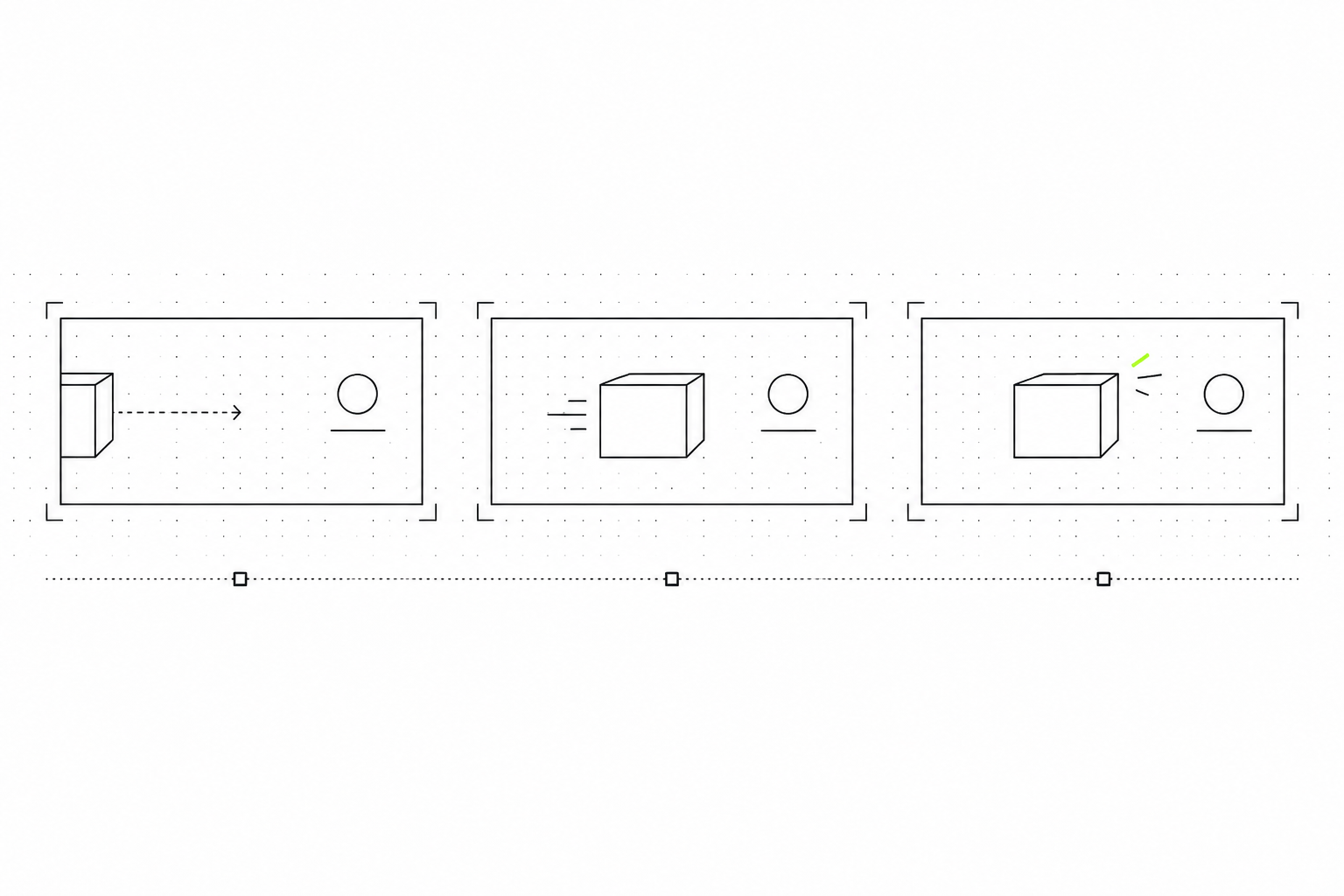
Animated banners can attract more attention to your brand and communicate offers more clearly when the movement serves a specific purpose. But they are not automatically more effective than static ads: the message, advertising environment and campaign objective are what matter. Animation is particularly worthwhile when it demonstrates a product benefit, tells a short story or enables a relevant interaction.
What animated banners can do for your brand
A static banner has to communicate its message in a single image. An animated ad can present content in sequence, show changes and direct attention towards an offer. This creates additional opportunities, but also additional risks: someone who sees the ad only briefly should not have to wait for the key information.
Attention is the starting point, not the outcome
Movement can draw the eye to an ad. Whether that translates into brand impact depends on what people notice next. If they remember only an eye-catching effect, but neither the brand nor the product benefit, the animation has missed its purpose.
As the client, your priority should therefore not be how spectacular a banner looks. What matters is whether your brand remains recognisable and the intended message is clear even at a glance.
Complex benefits become easier to understand
Animation is particularly useful when a single image cannot adequately explain a benefit. A configurable piece of furniture, the application of a skincare product or a digital service can all benefit from a short visual sequence.
For a simple price offer, however, a static ad may already do everything needed. Adding movement would not necessarily make it more persuasive.
When animation is worthwhile and when it is not
The decision should start with the communication challenge, not a personal preference for motion design.
| Campaign scenario | Considerations for the client |
|---|---|
| Product launch with a benefit that needs explaining | Animation can clearly connect functionality with benefits. |
| Brand building with a recognisable visual identity | Movement can support the brand presentation, provided the brand appears early. |
| Simple offer with a clear price advantage | A static ad may be enough. Animation needs to add value. |
| Multiple products within one campaign | Animation can showcase a range, but must not overshadow the core message. |
| Campaign with a very tight production budget | Fewer, clearer ads are often a better choice than elaborate effects. |
| Promotion with a meaningful choice or interactive experience | Rich media can be suitable if the interaction serves the campaign objective. |
The same fundamental questions apply to a regional campaign in Upper Austria as to a brand campaign across Germany, Austria and Switzerland. Larger campaigns often involve additional language, offer and format variations. This increases the need for coordination, regardless of how elaborate the individual animation appears.
Animated banners, HTML5 and rich media: What you are buying
These terms are often used interchangeably. The distinction matters for your budget decisions because the scope of work and delivery options differ.
Standard animated banners
These ads change over time, for example through moving product elements or a sequence of messages. They do not necessarily include any interaction beyond a standard click.
HTML5 is a technical foundation for these ads, not a promise of effectiveness in itself. With professional HTML5 banner production, you are paying not only for design and animation, but also for adaptation to booked formats, compliance with technical specifications and quality assurance. An animated GIF is another option, although it has different creative and technical limitations.
Rich media with additional functionality
Rich media goes beyond movement alone. Depending on the ad placement, it can include interactive product views, selection options or embedded videos. Not every media seller or inventory source supports every feature.
The added value lies in getting people to engage with your offer. For a product that needs explaining, a relevant interaction can be useful. For a brief discount message, it may simply create an extra hurdle.
Rich media is therefore more likely to be worthwhile when sufficient budget, suitable placements and a clear benefit from the interaction come together. Technical feasibility alone is not a good reason to buy it.
How to assess effectiveness meaningfully
A higher click-through rate does not automatically prove stronger brand impact. Conversely, an ad can contribute to brand recognition without generating many direct clicks. The results that matter must align with the campaign objective.
Relevant metrics include:
- For brand building: viewable impressions and reach, supplemented where appropriate by a suitable ad recall study.
- For interest: qualified website visits and genuine engagement with relevant content.
- For sales: purchases or enquiries, along with their quality and cost.
- For rich media: interactions as an additional signal, not a substitute for business outcomes.
Comparisons between animated and static ads are only reliable when differences in audiences, placements and offers are taken into account. Otherwise, the influence of the advertising environment may be mistakenly attributed to the animation.
With programmatic advertising, creative development and media planning should therefore go hand in hand. A good banner cannot compensate for unsuitable delivery conditions. Nor does an impression that meets technical viewability criteria guarantee that someone consciously notices the ad.
What animated banners cost and what drives the budget
It is difficult to give a credible fixed price without knowing the required formats and campaign requirements. A simply animated ad based on an existing design is a different brief from an original rich media concept with multiple interactions.
The main cost drivers are:
- Concept development: Is there already a viable campaign idea, or does one need to be developed?
- Assets: Are suitable product images, videos and brand guidelines available?
- Variations: How many formats, languages, offers and markets are planned?
- Functionality: Is animation enough, or are interactive elements needed?
- Approval: How many stakeholders and revision rounds are planned?
- Delivery: Will there be additional costs for technology, hosting or special ad placements?
Ask for production, any additional services and the media budget to be itemised separately. This makes it clear what you are paying for and which changes will incur extra costs.
Animation makes financial sense when its expected contribution to the campaign justifies the additional effort and expense. For smaller campaigns, a simple, consistent design can be a better investment than an elaborate bespoke solution.
Mistakes that waste budget
The message arrives too late
If the brand and offer only appear at the end, understanding the ad depends on whether someone watches for long enough. That is a risky foundation for display advertising. A good agency therefore assesses not just the full sequence, but also what comes across at a glance.
The ad does not suit the booked placement
Technical requirements, mobile display and available features should be clarified before final production approval. Otherwise, you risk rework or limitations shortly before the campaign launches.
Excessive movement can also become a problem if it compromises readability or accessibility. Attention should not come at the expense of usability.
Interaction is mistaken for purchase intent
A playful element can spark curiosity without generating relevant demand. If your objective is qualified enquiries, rich media must be judged against that goal. High interaction numbers alone do not justify a more expensive execution.
For features involving tracking or data collection, privacy and consent need to be addressed early. The specific implementation should undergo legal review for Austria or the relevant markets in Germany, Austria and Switzerland.
How to identify the right agency
A good agency does not automatically recommend the most elaborate option. It can explain why movement helps your specific message and where a static ad is sufficient.
The proposal should clearly describe the concept, required formats, variations, revisions, technical testing and responsibilities. Your project needs clear approval stages and realistic coordination with media planning.
When reviewing references and work samples, look beyond the effects. What matters more is whether the brand, product and call to action work together, and whether the design remains effective in small ad spaces.
Frequently asked questions
Are animated banners always better than static banners?
No. They offer additional creative options, but no automatic advantage in effectiveness. For a simple message or a tight budget, a static banner may be the more sensible choice.
Is rich media worthwhile for regional businesses too?
Yes, if it suits the product, campaign objective and available placements. But the additional effort and expense must be just as clearly justified for a regional business in Vienna or Linz as for an international brand.
What does the agency need to provide a reliable assessment?
Above all, the campaign objective, target audience, campaign duration, planned media budget, ad placements and existing assets. These make it possible to assess whether static banners, animation or rich media offer the most appropriate scope for the campaign.
First decide what your ad needs to achieve, then determine how much animation it needs. artworx handles concept development, HTML5 banner production and coordination with ad delivery. A 45-minute consultation can help clarify which option suits your brand and your budget.