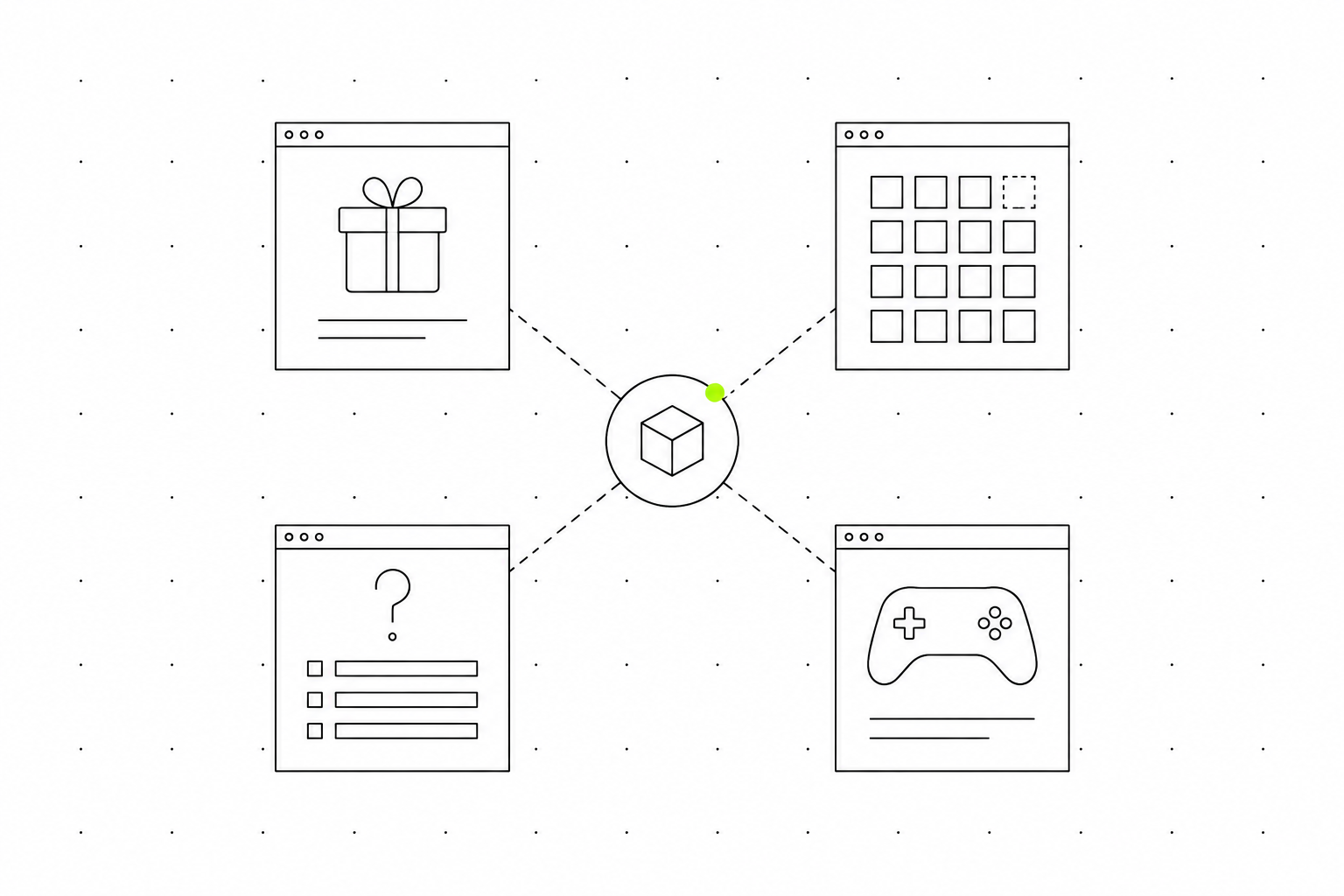
Online promotions turn an advertising impression into active engagement with your brand. The main types include prize draws, online Advent calendars, quizzes and minigames. Depending on their mechanics, they support different goals: awareness, repeat engagement, product interest or qualified lead generation. The right choice depends less on entertainment value alone than on your audience, the occasion and the desired outcome.
Why Online Promotions Work for Brands
Traditional advertising communicates a message. An online promotion gives people a specific reason to engage with it. They answer a question, discover an offer or complete a short, playful challenge. This can turn fleeting attention into a conscious interaction with your brand.
The connection between the activity and the brand is crucial. A generic grand prize may attract plenty of entries without increasing interest in the company. A relevant product prize or a product feature brought to life through play, on the other hand, creates a clear connection to what you offer.
For you as the client, three outcomes are particularly relevant:
- Activation: Your audience gets an immediate reason to respond to your communications.
- Engagement: Products, services or brand values become part of an active experience.
- Relationship building: Repeat visits or voluntary consent can create opportunities for further contact.
None of these outcomes happens automatically. That is why professionally designed online promotions and prize draws combine an engaging participation concept with a clear marketing goal and a suitable distribution strategy.
Online Promotions: Types and Best Uses
The four formats differ primarily in how much attention they require and what reason they give people to take part.
| Type | Particularly suited to | Strength | What to consider |
|---|---|---|---|
| Prize draw | Promotional campaigns, product launches, lead generation | An easy-to-understand reason to enter | The prize must suit the target audience |
| Online Advent calendar | Seasonal campaigns, customer retention | Recurring opportunities for engagement | Content and ongoing management throughout the campaign |
| Quiz | Product understanding, guidance, brand knowledge | Combines interaction with information | Questions must be relevant and accessible |
| Minigame | Brand activation, experiences, events | Playful engagement with the brand | The game concept must not overshadow the brand message |
Prize Draw: When You Need a Clear Incentive to Drive Action
A prize draw is a good fit when you need a low barrier to entry and an incentive that is easy to understand. Typical occasions include a product launch, an anniversary or a joint campaign with retail partners. It can run on a campaign page, with traffic driven by newsletters, social media or paid advertising.
Its strength lies in how easy it is to explain. At the same time, a prize draw also attracts people who are mainly interested in the prize. A high number of entries is therefore not proof of quality leads or future sales.
Pay particular attention to the prize you choose: an appealing prize from your product range or an experience closely connected to your brand may be a better fit than an expensive generic prize. If the campaign is intended to generate newsletter subscribers, the required consent process must be legally reviewed and clearly structured.
Online Advent Calendar: When Repeat Engagement Matters
An online Advent calendar creates multiple opportunities for engagement in the run-up to Christmas rather than a single entry. Behind each door, participants might find prizes, offers, content or small interactive activities. The format is particularly well suited to brands with a seasonal focus and enough relevant topics to draw on.
For retailers, tourism businesses or consumer goods brands in Austria, for example, it can showcase products and services over several days. Existing customers have a reason to return, while new visitors discover different aspects of the offering.
This added value comes with ongoing work. Prizes, content, enquiries and communication with winners need to be managed throughout the campaign. An Advent calendar is therefore more than a single prize draw with a Christmas theme. Our article on the online Advent calendar as a marketing tool explains the key requirements on the client side.
Quiz: When You Want Your Audience to Understand Something
A quiz is a good choice when your brand wants to communicate more than a name or a prize. Questions can explore product features, use cases or topics relevant to your customers' everyday lives. The result can offer guidance, such as identifying which product category suits a particular need.
This makes the format particularly useful for offerings that need more explanation. Insurers, tourism companies or technical brands can make complex topics more accessible without making participation feel like an exam.
The limiting factor is your audience's attention. Too many questions or assumed specialist knowledge can cause people to drop out. A quiz is particularly worthwhile when taking part delivers a small insight in itself. For products that require in-depth advice, the result must not give the impression of providing personalised professional guidance.
Minigame: When You Want People to Experience Your Brand
Minigames are short games, such as search, skill or reaction games. They suit campaigns centred on experiences and playful engagement. Potential uses range from product launches and sports partnerships to trade fair appearances.
The game concept should connect to the brand. If collecting, precision or discovery are relevant to your products, for example, the game mechanics can bring those qualities to life. A generic game with a logo added afterwards makes little use of this potential.
Minigames usually require more bespoke concept development and quality assurance than simple prize draws. In return, they offer greater creative freedom. What matters is not technical complexity, but whether the audience quickly understands why the game is interesting and which brand is behind it.
Which Promotion Type Suits Your Marketing Goal?
For quick activation, a prize draw is often the obvious choice. If you want to maintain a presence over several weeks, an Advent calendar may be a better option. If the goal is product understanding, a quiz is often more suitable. If you want to bring a brand promise to life through play, a minigame can be compelling.
Your relationship with the audience also matters. Existing customers usually have more context than people encountering your advertising for the first time. A promotion aimed at audiences unfamiliar with your brand therefore needs to make its value clear immediately.
Combinations are possible, such as a quiz with a chance to win. However, adding more mechanics does not automatically make a promotion more effective. Every additional requirement needs to offer a clear benefit. Otherwise, it simply raises the barrier to participation.
Roughly How Much Does an Online Promotion Cost?
Without a defined scope, a flat price would tell you very little. A simple prize draw on an existing platform generally involves less work than a bespoke minigame. An Advent calendar can also become a larger project because of the amount of content and ongoing management involved.
When assessing the budget, look beyond design and technical delivery. Depending on the project, you may also need to account for prizes, advertising materials, media spend, campaign management, shipping and legal review. Integrations, multiple languages or specific data security requirements can add to the workload.
Compare proposals by scope rather than total price alone. Check whether mobile quality assurance, hosting, reporting and support are included. A clearly defined solution is more cost-effective than an apparently cheap starting point with unclear extras.
Mistakes That Waste Budget and How to Recognise a Good Partner
A common mistake is assuming that an appealing promotion will attract visitors on its own. Even a strong campaign needs the right traffic. Another is judging success solely by entry numbers: for lead generation, it also matters whether the right people are taking part and whether valid consent has been obtained.
A suitable agency will therefore start by asking about your goals, audience, distribution and success criteria. It can explain why a format is suitable, what its limitations are and which tasks your team will need to handle. Responsibilities for the concept, approvals, quality assurance, campaign management and final reporting should be clearly assigned.
For campaigns in Austria or across multiple DACH markets, entry terms, data protection, age limits and any country-specific requirements need to be addressed early. Have these points reviewed by qualified experts. Technical implementation is no substitute for a legal assessment.
Frequently Asked Questions
Which Online Promotion Is Suitable for a Small Budget?
A prize draw with a clearly defined scope can be a sensible starting point. Existing reach and a suitable prize are crucial. Alongside production, budget for advertising, campaign management and legal review.
Do Online Promotions Automatically Bring in New Customers?
No. Taking part initially shows interest in the promotion. Whether a participant becomes a customer depends on factors such as audience fit, the offer and whether further communication is permitted. Entry numbers alone do not demonstrate sales success.
Can a Promotion Run in Austria, Germany and Switzerland?
In principle, yes. Language, prize availability, shipping and legal requirements must suit each market. A shared design does not automatically mean the same entry terms will be sufficient everywhere.
Choose the format based on the outcome you want, not on entertainment value alone. artworx, based in Linz and Vienna, handles the concept and implementation of your online promotion. An initial conversation can help establish which type suits your brand, timeline and budget.